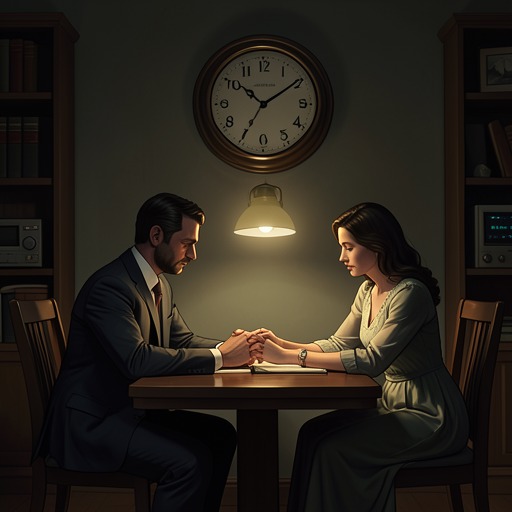
Cause and effect cycle
The Time Traveler's WifeCausal loops in The Time Traveler’s Wife are the interlocking relations among events that Henry DeTamble encounters at different points in time. Because his time travel is involuntary, he does not simply revisit the past to alter it: he arrives inside lives and histories already unfolding, sometimes carrying knowledge that other people do not yet have. The novel’s dated episodes make the loop a matter of both plot and form, requiring readers to connect scenes across discontinuous timelines and shifting ages.
Definition and Operation
Henry explains causal loops as part of the practical and genetic account of his time-travel condition. Describing the condition to colleagues, he connects it to a disease he cannot control, and explains how it has shaped his efforts to live an ordinary life. His account places causal loops among the scientific concepts he invokes, including quantum mechanics, photons, and the speed of light; in the novel, however, the concept is embodied less as a detached theory than as a constraint on lived experience.
The chronology makes the constraint visible. A section dated October 26, 1991 identifies Henry as twenty-eight and Clare as twenty, while another shifts between January 2, 1988, when Henry is twenty-four, and June 16, 1968, when he is five. Later entries similarly pair October 27, 1984, with January 1, 2007, and set a July 24, 2053 encounter between Henry, aged forty-three, and Clare, aged eighty-two. The dates do not form a straightforward sequence of cause followed by effect; they present points in Henry’s life that readers must relate across time.
Encounters Across Unequal Timelines
The first date between Henry and Clare demonstrates how a shared relationship can occupy sharply different positions in the two characters’ lives. On October 26, 1991, Clare enters the Newberry Library for the first time, signs the visitors’ log, and pursues research for an art-history paper. The same dated scene identifies Henry as twenty-eight and Clare as twenty. Their meeting belongs to a history the reader has to piece together from episodes presented at different dates, rather than from a single continuous courtship.
The temporal imbalance also reaches into the intimate present. In a scene dated February 9, 2000, Clare wakes when Henry materializes beside her after being elsewhere; the sudden arrival frightens them both, and she discovers that his mouth is bleeding. A separate entry places Clare awake in bed at 3:14 a.m. when Henry quietly comes in and joins her. These episodes show the recurring domestic consequence of his displacement: even a shared bed cannot guarantee that both spouses inhabit the same stretch of time or arrive there by the same route.
Family History and Repetition
Henry’s time travel repeatedly brings him into the past of his own family. He sees his mother alive in the 1960s, watches his parents together, and observes scenes from his childhood, including his mother caring for him as a baby and walking with him as a small child. He sometimes speaks to her in passing, while his parents take him for an ordinary neighborhood presence. His father never recognizes that the unusual man he sees around the early years of his marriage is his own son. The visits create a loop of recognition that is complete for Henry but remains closed to the people he observes.
The family’s later history acquires additional force against those remembered scenes of happiness. Henry recalls his mother’s death and reflects that her absence shaped his father’s life; what he once did not understand, he comes to recognize as an absence that remains present. In this account, temporal visitation cannot restore the lost future or erase bereavement. Instead, the remembered and witnessed past gives Henry knowledge of what his family life contained, while its losses remain part of the same history.
The Loop in Family and Narrative
The novel places its recursive time structure beside the continuity of family relationships. At Alba’s birth, Henry’s father, Richard, enters the room carrying flowers and a teddy bear. Henry invites him to hold the baby, and Richard’s smile transforms his face as Alba settles against him and falls asleep. The scene brings three generations into one room, but it does not erase their histories: Richard’s difficult relationship with Henry and Henry’s memories of his parents remain part of the family past that the new child inherits.
The dates and alternating first-person accounts make readers perform a reconstruction parallel to Henry’s own unusual experience of chronology. A meeting can be a first encounter for one person and a later point in an established relationship for another; a family scene can be witnessed by Henry as an adult even though those around him understand it as ordinary life. The resulting structure links scenes by recurrence, emotional consequence, and unequal knowledge rather than by simple chronological succession.
Limits, Loss, and Return
Causal connection in the novel does not amount to mastery over time. Henry describes his condition as uncontrollable, and his account includes the fear, deception, and theft involved in trying to maintain a normal life. The loop therefore has a double character: it grants him access to people and moments otherwise lost to him, but does not give him the power to make time obedient or to prevent absence from taking its course.
That limit is especially clear in the final meeting set on July 24, 2053. Henry finds Clare as an old woman, her hair white, seated at a table by a window overlooking the lake. When she turns and recognizes him, joy remakes her face; she slowly comes to him, and he takes her into his arms. The encounter gives their story a return across an extraordinary span of time, but not a return to their former ages or a cancellation of the years between them. The loop’s emotional resolution lies instead in recognition: after repeated separations and unequal passages through time, Henry and Clare meet again.